
Last July, I packed the kids into a hire car at 7am, convinced we'd squeeze in a trip to Nicosia, lunch in a mountain village, and be back at the beach by sunset. By 2pm we were sitting in traffic near Larnaca, my seven-year-old asking if Cyprus was actually just one giant car park, and I realised something: day trips from Protaras need proper planning, or they become endurance tests rather than adventures.
After 12 summers here since 2014, I've learned what genuinely works with children and what sounds brilliant on the tour operator's brochure but leaves you exhausted and the kids fractious. This guide covers the destinations that are actually worth your time, how long they really take, what to expect with kids, and how to build a balanced week without losing your mind.
The Reality of Distances from Protaras
Protaras sits on the eastern tip of Cyprus, which is both brilliant (quiet, family-friendly, Fig Tree Bay) and limiting (everything else requires a drive). Before you book anything, understand the geography. The coast road winds, traffic near Larnaca can be sluggish, and mountain roads aren't motorways.
Here's what you're actually looking at:
| Destination | Distance (km) | Drive Time | Best For |
|---|---|---|---|
| Cape Greco | 8 | 15 mins | Families, any age |
| Paralimni town | 5 | 10 mins | Shopping, lunch |
| Larnaca Old Town | 45 | 50 mins–1 hour | History, restaurants |
| Salt Lake (Larnaca) | 48 | 55 mins | Nature, photos |
| Nicosia (Old City) | 85 | 1.5–2 hours | Culture, older kids |
| Troodos Mountains (Platres) | 110 | 2–2.5 hours | Cooler weather, hiking |
| Blue Lagoon (Akamas) | 180 | 3–3.5 hours | Beach lovers, long day |
Those times assume decent traffic and you know where you're going. Add 20 minutes if you're hunting for parking or following Google Maps through narrow streets. On a Friday in summer, add another 15–20 minutes to anything heading west towards Larnaca.
Cape Greco: The No-Brainer Day Trip
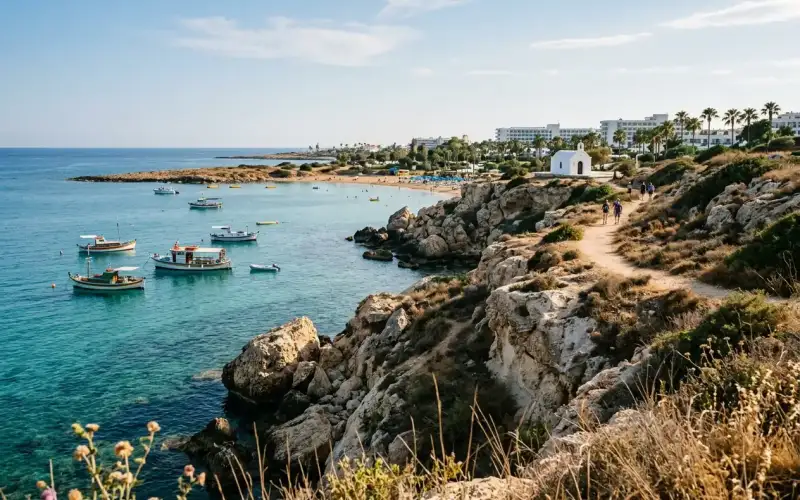
If you do one trip beyond your hotel, make it Cape Greco. It's 15 minutes from central Protaras, costs nothing to visit, and offers something for everyone: sea caves, walking trails, dramatic cliffs, and a lighthouse. We've been dozens of times, and it never gets old.
The main car park is signposted from Protaras town centre and fills up by 10am in summer. Go early or after 4pm. There's no café at the car park itself, though a couple of tavernas sit nearby on the approach road. Bring water and snacks.
The walking trail loops around the headland and takes about 90 minutes at a leisurely pace with kids. The paths are well-maintained but rocky in places, so proper shoes matter—flip-flops won't cut it. My five-year-old managed it fine, but he was motivated by the promise of ice cream after. The sea caves are accessible from the path, and the views back towards Fig Tree Bay are genuinely stunning.
If walking doesn't appeal, you can just park, walk 10 minutes to the lighthouse, take photos, and leave. That's perfectly legitimate. The whole visit can be two hours or four hours depending on your mood. There's no entrance fee, no time limits, and no pressure.
What to Bring and When to Go
Sun cream is essential—the cliffs offer minimal shade. A hat, sunglasses, and plenty of water. If you're going in July or August, start early. By noon, the exposed paths become genuinely hot, and small kids will struggle. May, June, September, and October are perfect: warm enough for swimming, cool enough to walk comfortably.
The sea at Cape Greco is rockier than Fig Tree Bay, but there's a small sandy beach near the car park if you want a quick paddle. It's not a proper swimming spot—the rocks and currents make it less safe for young children—but it's scenic.
Larnaca: History, Lunch, and the Salt Lake
Larnaca is Cyprus's oldest city and sits about 50 minutes south of Protaras. It's worth a day trip if you want to break up beach time with culture, decent restaurants, and a change of scenery. The old town has narrow streets, the seafront promenade (the Piale Pasha) is pleasant for a walk, and there are proper museums if your kids are into that sort of thing.
The Church of Saint Lazarus dominates the old town and is genuinely impressive inside, though it's more interesting for adults than children. Nearby, the Medieval Castle (Larnaca Castle) offers views and a small museum, but it's a bit sparse and can feel underwhelming after the hype.
The real draw for families is the Salt Lake, just outside Larnaca town. From November to March, it's pink with flamingos—genuinely magical if you time it right. In summer, it's just a salt lake, but it's still worth the short drive for photos and a change of perspective. There's a walking path around part of it, though it's exposed and hot. A 30-minute stroll is enough.
For lunch, the seafront has dozens of restaurants. Expect to pay €12–18 per main course at mid-range places. The fish is fresh, portions are generous, and most places have high chairs and kids' menus. Book ahead on weekends.
A realistic Larnaca day trip: leave Protaras at 8am, arrive 9am, spend 2–3 hours in the old town and castle, lunch 1–2pm, visit the Salt Lake 3–4pm, leave 4.30pm, back by 6pm. You'll feel like you've done something different without exhausting the kids.
Nicosia: Is It Worth the Drive?
Nicosia (Lefkosia) is the capital, split between Greek and Turkish Cyprus, and it's genuinely historically significant. The old walled city is UNESCO-listed, the museums are excellent, and the atmosphere is completely different from the coast.
But here's my honest take: it's a tough day trip with young children. The drive is 1.5–2 hours each way, the old city involves a lot of walking on narrow, hot streets, there's limited shade, and the museums require patience and attention. My kids were bored after 90 minutes, and we ended up sitting in a café eating pastries rather than actually exploring.
If you have older kids (10+) or teenagers, it's worth it. The Cypriot Museum is world-class, the street food is brilliant, and there's a real sense of stepping into history. The Ledra Street crossing between the two sides of the city is surreal and memorable. But for primary-age children, it's a long day for limited payoff.
If you do go: start early, park near the old city (it's a maze), spend 2–3 hours exploring, have lunch at a proper restaurant (not a tourist trap), and skip the museums unless your kids are genuinely interested. The street food scene is the best bit—souvlaki, halloumi, pastries, fresh juice.
Troodos Mountains: Cooler Days and Village Life
The Troodos mountains sit roughly 2–2.5 hours from Protaras and offer a completely different Cyprus: pine forests, cooler temperatures (sometimes 10 degrees cooler than the coast), traditional villages, and hiking. It's brilliant for breaking up a beach-heavy week.
Platres is the main tourist village and has restaurants, a small museum, and plenty of walking trails. The drive up is winding but straightforward, and the scenery improves as you climb. We usually stop in Omodos, a prettier village about 20 minutes before Platres, which has a proper monastery, wine bars, and a more authentic feel.
The villages feel sleepy compared to the coast, which is either relaxing or boring depending on your mood. There's not much to do beyond walking, eating, and sitting in cafés. But if you want a day away from the beach and the kids are happy to explore on foot, it works well.
What to do: hike one of the marked trails (most are 1–2 hours), visit Omodos monastery, have lunch at a traditional taverna (expect €10–15 per main), and maybe pick up some local wine or halloumi to bring home. The whole day feels slower and more restorative than a coastal trip.
When to go: May to October. In winter, the mountains can be cold and wet. In July and August, they're cooler than the coast but still warm enough to hike comfortably in the morning.
Blue Lagoon and Akamas: A Full Day Adventure
The Blue Lagoon sits on the Akamas Peninsula, roughly 3–3.5 hours from Protaras. It's stunning—turquoise water, white sand, accessible only by boat or a long walk. Most visitors book a boat tour from Paphos, which costs €35–50 per adult and €20–30 per child.
Here's the thing: it's beautiful, but it's also exhausting as a day trip from Protaras. You're looking at 3.5 hours driving plus 4–5 hours on a boat with potentially dozens of other tourists. The boat is usually packed, the sun exposure is intense, and younger kids can get restless.
If you're based in Paphos or Coral Bay, it makes sense. From Protaras, it's a stretch. Unless your kids are strong swimmers and genuinely excited about a boat trip, I'd skip it and spend the day at Fig Tree Bay instead. You'll save money, avoid the drive, and actually relax.
If you do book it: go with a reputable operator, take seasickness tablets if anyone's prone, bring extra sun cream, and pack snacks. The water is cold even in summer, so bring a rash vest or wetsuit for the kids.
Paralimni Town and Local Shopping
Only 10 minutes from central Protaras, Paralimni is where locals actually live and shop. It's not a tourist destination, which is exactly why it's worth visiting. The main square has proper tavernas, a supermarket, a market (if you catch it on the right day), and a genuine slice of Cypriot life.
We often pop in for lunch on a Tuesday or Thursday, park near the square, and eat at one of the family tavernas. Prices are lower than beachfront restaurants, portions are enormous, and you'll see actual Cypriot families rather than tourists. It's a 2–3 hour trip if you combine it with shopping or a long lunch.
The market (farmers' market) runs on certain days and sells fresh fruit, veg, and local products. It's worth timing your visit around it if you're self-catering.
Planning a Balanced Week: Honest Tips
After 12 summers, here's what I've learned about building a week that doesn't burn you out:
- Do two proper day trips maximum. One local (Cape Greco), one further afield (Larnaca or Troodos). The rest of the time, stick to Fig Tree Bay, the hotel pool, and Paralimni. You came for the beach, not to spend your holiday in a car.
- Leave early, come back early. An 8am start means you miss traffic and the kids are fresher. Being back by 6pm means dinner isn't a nightmare and bedtime isn't chaos.
- Combine destinations. If you're going to Larnaca, add the Salt Lake. If you're heading to Nicosia, stop in a mountain village on the way back. This makes the drive feel worthwhile.
- Book restaurants ahead. Especially for lunch. Wandering around hungry with kids is a recipe for meltdown.
- Hire a car. Tours are convenient but expensive (€50–80 per person) and you're stuck to their schedule. A hire car costs €25–35 per day and gives you flexibility. Worth it.
- Don't try to do everything. Cyprus is small, but distances add up with kids. Pick three or four destinations and do them properly rather than rushing through six.
Practical Information: Costs, Hours, and What to Book
Most attractions don't require advance booking. Cape Greco is free. Museums cost €5–8 per person. Restaurants average €12–20 per main course at mid-range places. Hire cars cost €25–40 per day depending on season and car size.
Petrol is roughly €1.30–1.50 per litre (2026 prices), so budget €10–15 for a full tank and a 100km round trip. Tolls don't exist in Cyprus, which is a relief.
Most shops and museums close 1–4pm for a siesta, which is annoying but also means you can plan lunch into your day trip without losing access to attractions. Banks and government buildings are closed on weekends and public holidays.
For boat trips or organised tours, book through your hotel or a local operator. Prices are similar everywhere, but local operators often know the best times to visit and can be more flexible if the kids need a break.
The best day trip is the one you actually enjoy, not the one that sounds impressive when you're telling people back home. If your kids are happy at the beach, stay at the beach. If they're bored, take them somewhere different. There's no right answer—just what works for your family.
When to Go: Seasonal Considerations
May, June, September, and October are ideal for day trips. The weather is warm but not scorching, attractions are less crowded, and driving is more pleasant. July and August are hot, busy, and exhausting. If you're visiting then, do day trips early in the morning and return by mid-afternoon.
November to March brings cooler weather and fewer tourists, which is brilliant if you like peace and quiet. But some smaller attractions have reduced hours, and the sea is too cold for casual swimming. The Troodos mountains are actually lovely in spring (April–May) when wildflowers are out.
Christmas and Easter weeks are chaos everywhere. Avoid if you can.
Final Thoughts: Making Day Trips Work
Day trips from Protaras work best when you're realistic about what you can fit in, honest about what the kids will actually enjoy, and willing to abandon plans if things aren't working. Some of our best holidays have involved scrapping the scheduled trip and spending an extra day at Fig Tree Bay with a good book.
Cape Greco is genuinely worth doing—it's close, free, and offers something different without the stress of a long drive. Larnaca works well for a cultural break and a change of pace. Nicosia is brilliant if you have older kids. The Troodos mountains are perfect for a cooler day and a different atmosphere. The Blue Lagoon sounds amazing but is exhausting from Protaras.
Whatever you choose, leave early, book restaurants ahead, bring water and sun cream, and don't try to cram too much in. You're on holiday. The point is to enjoy yourself, not to tick off every attraction in Cyprus.
Comments (3 comments)