
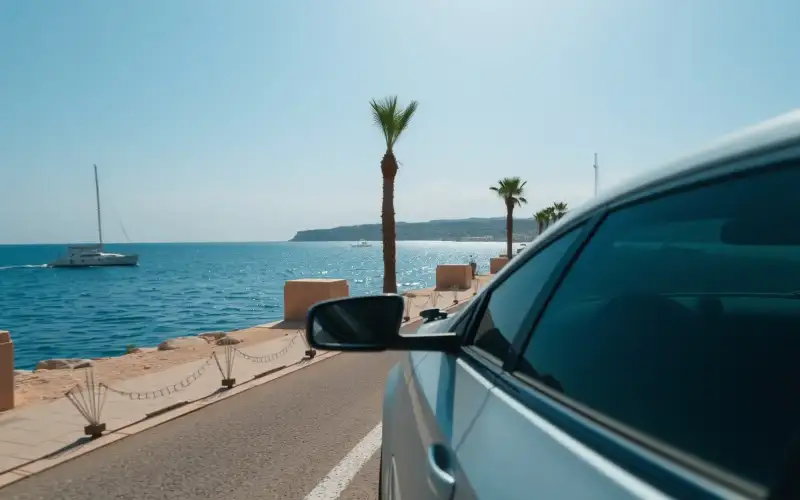
I'll never forget the moment my seven-year-old spotted a car driving on the left side of the road—from the right side of the road. We'd just landed in Protaras, collected our rental Hyundai i10, and I was gripping the steering wheel like it might escape. "Dad, they're doing it wrong," she announced confidently. Turns out, we were. Cyprus drives on the left, and that first ten minutes navigating the car park at Hermes Rent-a-Car felt like learning to drive all over again.
If you're planning a family holiday to Protaras in 2026 and wondering whether to hire a car, the answer for most British families is yes—but with some solid preparation. A rental gives you freedom to explore beyond the resort strip, hit quieter beaches, and discover tavernas that don't have "family-friendly" in neon letters. But it also means understanding what you're getting into: Cyprus roads are narrow in places, parking at beaches requires strategy, and child seat laws are strict. This guide walks you through everything you need to know before you drive away from the rental desk.
Why Rent a Car in Protaras?
Protaras itself is compact—you can walk the main strip in about twenty minutes—but the real magic happens when you venture out. The quieter beaches at Konnos Bay (about 2 kilometres south) are stunning and far less crowded than the central seafront. The Paralimni lake, just inland, is perfect for a picnic lunch and spotting egrets. And if you're willing to drive thirty minutes north to Famagusta's old town or west towards the Akamas Peninsula, you'll find landscapes and history that justify every penny of a rental.
Public transport exists—the local buses are cheap and cheerful—but with young children, a rental car means no waiting at stops in 38-degree heat, no wrestling a buggy onto a crowded coach, and the freedom to leave a beach at 2 p.m. if your youngest is melting rather than waiting for the next scheduled service.
That said, if your holiday is entirely resort-based and you're happy with guided excursions, you might skip it. But for families wanting to explore at their own pace, a car transforms a week in Protaras from pleasant to genuinely memorable.
Booking Your Rental: When and Where
Start looking at car hire about six to eight weeks before your trip. The peak season (July and August) sees prices spike and availability tighten, especially for family-sized vehicles. I've seen a small automatic hatchback jump from €25 per day in early June to €45 in mid-July. Book direct with the rental company's website if possible—they often have better rates than aggregator sites like Rentalcars or Kayak, though it's worth checking both.
The big international names (Hertz, Avis, Enterprise) have desks at Larnaca Airport, about 45 kilometres west of Protaras, but local companies like Hermes, Budget Cyprus, and Thrifty often undercut them by 20–30 percent. Local firms also tend to have better knowledge of Protaras-specific parking and road conditions. Just read reviews carefully—you want a company that's transparent about insurance and doesn't hit you with surprise charges.
What to check when booking:
- Insurance excess (damage waiver). The standard excess is usually €500–€800. You can reduce it to €0 for an extra €8–€12 per day. Worth it with kids in the car.
- Fuel policy. Most rentals are "full to full"—you collect with a full tank and return it full. Some offer "full to empty" (you return empty) but these are rarer and usually more expensive overall.
- Child seat availability. Book this in advance if needed—not all companies have them, and last-minute additions cost €15–€25 per day per seat.
- Automatic vs. manual. Automatics cost 15–20 percent more but are easier if you're not used to left-hand driving. Worth the extra on narrow Cypriot roads.
- Vehicle size. More on this below.
Choosing the Right Vehicle Size
This is where most families make their first mistake. You think you need a big SUV because you have luggage and kids. You don't. Protaras roads, especially heading inland towards villages like Paralimni or Sotira, are narrow—some barely wide enough for two cars to pass. A large SUV or seven-seater will feel cumbersome, parking is a nightmare, and fuel costs spike.
For a family of four with a week's luggage, a compact automatic hatchback (Hyundai i10, Fiat 500, Renault Clio) is ideal. You'll fit two child seats in the back comfortably, the boot handles a week's worth of bags, and you can navigate tight village streets and car parks without sweating. If you have five people or need significantly more space, a small MPV like a Citroën C3 Picasso works well.
A mid-size SUV (Nissan Qashqai, Hyundai Tucson) is tempting but honestly overkill for Protaras. You'll spend an extra €15–€20 per day, struggle to park at beaches and tavernas, and burn through fuel faster on those winding roads. Save the money.
| Vehicle Type | Best For | Daily Cost (2026) | Pros | Cons |
|---|---|---|---|---|
| Compact hatchback (automatic) | Families of 3–4 | €25–€35 | Easy to park, fuel-efficient, nimble on narrow roads | Tight boot space for longer trips |
| Small MPV (automatic) | Families of 4–5, extra luggage | €35–€50 | More space, still manageable on roads | Higher fuel costs, trickier parking |
| Mid-size SUV (automatic) | Families wanting comfort | €45–€65 | Comfortable, good visibility | Difficult parking, expensive fuel, unnecessary for Protaras |
Child Seats and Legal Requirements
Cyprus law requires child seats for children under 1.35 metres tall or under 12 years old. This applies to all passengers, not just the front seat. Fines for non-compliance start at €85 and can go up to €300, plus points on your licence. More importantly, it's genuinely about safety on roads where speeds can be erratic and some drivers are, shall we say, creative with lane discipline.
Most car hire companies will provide seats for €10–€15 per day per seat if you book in advance. They're usually basic but functional. If your child is between about 4 and 10 years old, a booster seat is often sufficient and takes up less space than a full harness seat. Babies under two typically need a rear-facing infant seat, which takes up significant room.
Top tip: If you're hiring for more than five days, it's often cheaper to bring your own seat from the UK (check airline baggage policies) than pay daily rental fees. Airlines typically allow one car seat as a checked item free of charge on flights to Cyprus.
Always test the seat in the car before leaving the rental desk. Make sure it's secure, the belt routing is correct, and you understand how to install and remove it. Rental staff can seem dismissive about safety checks—don't let that stop you from being thorough. You're the one responsible if something goes wrong.
Driving on the Left: What You Actually Need to Know
Right, so you're British, you drive on the left at home, and Cyprus also drives on the left. Sounds straightforward. But here's the catch: your rental car is a left-hand drive (steering wheel on the left, like continental Europe). This is the opposite of what you're used to. Your instinct will betray you.
For the first 30 minutes, you'll feel like an alien. The steering wheel is where the passenger usually sits. Gear changes happen with your left hand instead of your right. Mirrors are mirrored. Your depth perception for the nearside (left) of the car is shot because you're sitting further from it than usual. It's genuinely disorienting, and no amount of reading about it prepares you for that first roundabout.
Here's what actually helps: drive slowly for the first hour. Seriously. Ignore anyone honking behind you. Protaras traffic is generally patient with tourists, and going 40 km/h instead of 50 km/h through unfamiliar streets is sensible, not cowardly. Avoid major roads and complex junctions until you've done at least 20 kilometres of gentle driving. The coastal road through Protaras itself is perfect for this—wide, quiet, and forgiving.
On roundabouts, remember: you're driving on the left, so you enter from the right and exit to the left. But because you're in a left-hand-drive car, your perspective is shifted. This trips up almost everyone. Take roundabouts slowly, watch other cars, and don't be embarrassed about hesitating.
One genuine advantage: with a left-hand-drive car, you're sitting closer to the centre of the road, which actually helps with narrow streets. You can see oncoming traffic better and judge your position more easily than you might expect. After the first hour, most people settle into it.
Key driving rules in Cyprus:
- Speed limits: 50 km/h in towns, 100 km/h on open roads, 130 km/h on motorways. These are enforced with speed cameras and fines are substantial (€85 minimum).
- Seatbelts are mandatory for all passengers, including rear seats.
- Mobile phones are illegal to use while driving, even hands-free.
- Drink-driving limits are strict (0.22 mg/100 ml breath). One glass of wine could put you over it.
- Headlights must be on during the day on motorways and outside built-up areas (a quirk of Cyprus law).
- You must carry a warning triangle, high-visibility vest, and a fire extinguisher in the vehicle. Rental companies provide these.
Parking at Beaches and Managing the Heat
Beach car parks in Protaras fill up quickly, especially Fig Tree Bay and Konnos Bay. In summer 2026, expect them to be rammed by 10 a.m. Arrive early—8:30 a.m.—or go in the late afternoon (after 4 p.m.) when families start leaving.
Parking fees vary. Fig Tree Bay charges around €2 for a few hours, €3.50 for the day. Konnos Bay is free but smaller and fills faster. Smaller, quieter beaches like Vroudia often have free parking and far fewer crowds. The trade-off is a slightly longer walk, but with young children, a less chaotic beach is worth it.
Never leave children or pets in the car while you're at the beach, even with windows open. Temperatures inside a parked car in Cyprus can reach 60°C in minutes. It sounds obvious, but it happens. If you're going for a swim, one adult stays with the car or you take turns.
Tinted windows help keep the interior cooler. Most rental cars in Cyprus have them. Still, when you return to the car after a few hours in the sun, the steering wheel will be hot enough to hurt. Bring a small towel or buy cheap cotton gloves from a supermarket.
Fuel Prices and Costs
Fuel in Cyprus is cheaper than the UK but not dramatically so. In 2026, petrol (95 octane) costs around €1.10–€1.20 per litre, diesel slightly less at €0.95–€1.05. A small hatchback will do roughly 45–50 miles per gallon on mixed driving; an MPV closer to 35–40 mpg.
For a week-long rental, expect to spend €40–€60 on fuel if you're doing moderate exploring (day trips to nearby villages, beaches within 30 km). If you're driving to Famagusta or the Akamas Peninsula, add another €20–€30.
Always fill up at major petrol stations (Shell, Caltex, Emporios) rather than small independent ones—fuel quality is more consistent and prices are transparent. Supermarket petrol stations (Carrefour, Alphamega) are occasionally slightly cheaper. Never run the tank below a quarter full; petrol stations are sparse in rural areas, and you don't want to be stranded searching for one at dusk.
Insurance and What Happens If You Damage the Car
Standard rental insurance covers third-party liability (damage to other vehicles or property) but your excess for damage to the rental car itself is usually €500–€800. This means if you scrape a wing mirror or dent a door, you pay the first €500–€800 of repairs; the insurance covers the rest.
Excess reduction (damage waiver) brings this down to €0 for an extra €8–€12 per day. Over a week, that's €56–€84. Many families find this worth it for peace of mind, especially with kids and unfamiliar roads. Read the small print: some policies exclude damage to tyres, windscreens, and undercarriage, so you might still be liable for these.
If you do have an accident or damage, report it to the rental company immediately—don't try to hide a scrape hoping they won't notice. They always notice, and attempting to conceal damage voids your insurance. Take photos of any existing damage when you collect the car and point it out to the staff member. Get a written note of this on your rental agreement.
Navigation and Getting Around
Google Maps works brilliantly in Cyprus. Download offline maps before you arrive (in case you lose signal) and use them for navigation. The app is far more reliable than any sat-nav system the rental company might offer, and it gives real-time traffic updates.
Protaras itself is easy to navigate—it's essentially one long coastal road with side streets leading inland. Getting lost is genuinely difficult. Inland villages are signposted, though signs are sometimes small or faded. If you're heading somewhere specific, put the address into Google Maps before you leave, not while you're driving.
Street parking in Protaras town centre is free but limited. Most restaurants and shops have small car parks. Parking is rarely a problem outside peak summer weeks. Just avoid leaving the car unattended in very remote areas or overnight in isolated spots—petty theft from vehicles does happen, though it's not common.
What to Check Before You Drive Away
The rental company will do a walk-around inspection when you collect the car. Don't rush this. Check:
- Existing damage: scratches, dents, chips, broken lights. Make sure everything is noted on the contract.
- Tyre condition and tread depth. Tyres must have at least 1.6 mm tread (the legal minimum), but more is safer.
- Windscreen and windows for chips or cracks.
- All lights work: headlights, brake lights, indicators, hazard lights.
- Wipers function (you might not use them, but check anyway).
- Air conditioning works and blows cold. In Cyprus heat, a broken AC is genuinely unpleasant.
- Doors, boot, and fuel cap open and close smoothly.
- Child seats are installed correctly if you've hired them.
- Spare tyre, jack, and warning triangle are in the boot.
Take photos of the car's condition on your phone—exterior, interior, odometer reading. This creates a record if there's a dispute when you return the car. It sounds paranoid, but it's standard practice and protects you.
Returning the Car and Final Tips
Return the car on time and with a full tank. Running late incurs penalties (usually €25–€50 per hour), and returning on empty means the rental company fills it at inflated rates (often €1.50+ per litre). Fill up at a petrol station about 15 kilometres from the rental office, allowing time to reach "full" on the gauge.
Before handing the keys back, do a final walk-around. Make sure you haven't left anything in the car—kids' toys, sunglasses, phone chargers. Check the boot, under seats, and the door pockets. The rental company will charge you €20–€50 for items left behind, and retrieving them later is a hassle.
Keep your rental agreement and insurance documents until your credit card statement arrives. Reputable companies charge fairly, but disputes occasionally happen. Having documentation makes resolution straightforward.
One last thing: if you've had a genuinely good experience with a rental company, book with them again next time. Consistency matters, and a company that treated you fairly once will likely do so again. By 2026, you might find yourself returning to Protaras with the same rental company, the same car type, and the confidence of someone who's done this before. That first nervous roundabout will seem laughably easy.


Comments (4 comments)