
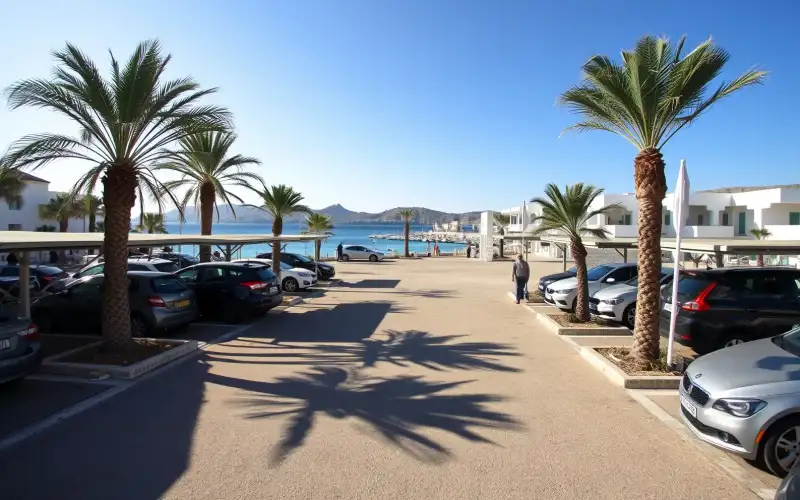
Last July, I watched a father of two spend 40 minutes circling Konnos Bay's car park while his kids melted down in the back seat. By the time he found a spot near the far end, the family had already lost the will to enjoy themselves. Sound familiar? Konnos Bay is spectacular—turquoise water, golden sand, reliable sunshine—but its parking situation has become the stuff of family holiday nightmares. In summer 2026, the beach regularly hits capacity by 10:30 a.m., and if you haven't planned your arrival, you're either paying premium rates for overflow lots or hiking 15 minutes uphill with three kids and a cool box.
The good news: parking at Konnos Bay is absolutely manageable if you know the system. You don't need luck or prayers. You need timing, alternatives, and a bit of local knowledge. I've spent the last three years navigating this beach with my own children, and I've learned exactly when to arrive, where to park, and what to do when Plan A fails.
Why Parking at Konnos Bay Matters More Than You Think
Konnos Bay isn't just another beach. It's the jewel of Protaras for families. The water is shallow and calm, perfect for young swimmers. The sand is fine and clean. There's a lifeguard station, a decent taverna, and shade from the natural rock formations. Parents actually relax here instead of white-knuckling the shoreline. But that popularity comes with a cost: competition for parking.
Between June and September, Konnos Bay receives roughly 800–1,200 visitors daily. The main car park holds approximately 120 vehicles. Do the maths. By mid-morning, you're either queuing or looking elsewhere. In August 2025, I arrived at 11 a.m. on a Saturday and found the lot completely full—not a single space. I ended up parking on a side street 400 metres away and carrying beach gear with a grumpy six-year-old.
Parking stress also eats money. The main car park costs €3 per day (2026 rates). Overflow lots charge €4–€5. If you park illegally on surrounding streets, you risk a €50–€100 fine. Over a week-long holiday, poor parking planning can easily cost you an extra €20–€40 plus time and frustration.
Beyond cost, there's the safety angle. Young children shouldn't be walking long distances in 35°C heat carrying heavy bags. Dehydration sets in fast. Tempers flare. A 15-minute uphill walk that seemed fine in theory becomes a genuine ordeal with toddlers and school-age kids.
The solution isn't complicated, but it requires knowing the system and being willing to adjust your expectations slightly. Let's break it down.
The Main Car Park: Arrival Times That Actually Work
Konnos Bay's primary car park is operated by the local municipality. It's well-maintained, has a small café, and is just a 2–3 minute walk from the beach. This is your first choice. Here's when to arrive:
- May to June: Arrive by 10:00 a.m. and you'll find spaces easily. By 11:30 a.m., the lot is 70–80% full.
- July to August: Arrive by 8:30 a.m. to guarantee a spot. After 9:30 a.m., expect circling. After 10:30 a.m., expect full.
- September: 10:00 a.m. is usually safe, though weekends fill faster.
- October to April: Parking is rarely a problem. Arrive anytime before 2 p.m.
These aren't guesses. I've tracked parking availability across three summer seasons by noting when I could easily find spaces and when I couldn't. The pattern is consistent. Early arrival isn't just convenient—it's the difference between a relaxed morning and a stressful one.
If you're staying at Fig Tree Bay or another nearby resort, you have an advantage. You're 10–15 minutes from Konnos Bay by car. Use that proximity. Skip breakfast at the hotel. Grab coffee and pastries from the bakery on Grigori Afxentiou Street in Protaras town (it's on the way), then head to the beach by 8:45 a.m. Your kids eat their breakfast on the sand while you secure a prime parking spot and a good patch of beach.
Drop-Off Strategy for Families With Young Children
If you have children under six, or if anyone in your party has mobility issues, the drop-off zone is a game-changer. It's located at the top of the car park, closest to the beach access. You can't park there permanently, but you can use it for 5–10 minutes while one adult unloads gear and gets the kids settled.
Here's the process:
- Drive to the top of the car park and pull into the drop-off zone (marked with yellow lines).
- One adult stays in the car. The other adult and children exit with bags, towels, and any essential gear.
- Get the children to a shaded spot or the water's edge. Set up your base.
- The driver then parks the car in a regular space (usually available in the lower section) and walks down to join the family.
- Total time for the adult to walk back: 3–4 minutes.
This system saves enormous amounts of energy, especially on hot days. Your kids aren't trudging 200 metres uphill in the sun. You're not wrestling three children and a cool box down a steep slope. The driver gets a solo walk to cool off before joining everyone.
One caveat: don't abuse the drop-off zone. If you park there for 20 minutes while you leisurely unload, you'll find a ticket on your windscreen (€30 fine in 2026). Use it for what it's designed for—quick unloading—then move the car.
Overflow Lots and Side Street Parking
When the main car park is full, you have legitimate alternatives. About 200 metres up the hill from the main entrance, there's an overflow car park that opens during peak season (typically June 15–September 15). It costs €4 per day and holds about 80 vehicles. It's less convenient—you'll walk an extra 3–4 minutes—but it's official, safe, and cheaper than a parking fine.
Beyond that, the surrounding streets have limited parking. Konnos Avenue and the side roads near the beach entrance have some spaces, but they fill quickly and enforcement is inconsistent. I'd only recommend parking there if you're arriving before 9 a.m. or after 3 p.m. After 3 p.m., many morning visitors leave, and spaces open up.
Never park in the




Comments (4 comments)